
 Massad Ayoob — Founder, Massad Ayoob Group · Retired Police Captain · Expert Witness on use of force · Review date: October 31, 2026
 Chris Raper — Retired North Carolina law enforcement (40+ years) · U.S. Air Force Security Police · NRA-certified Pistol, Rifle & Shotgun Instructor · NC DOJ-certified Concealed Carry Instructor · Founder, Concealed Handgun Carry, Inc. (Elm City, NC, 2006)
In addition to my own research and what my students bring into the Concealed Handgun Carry class every week, this guide was reviewed by Massad Ayoob of Massad Ayoob Group, whose opinion appears below. [Keep only if true — Chris: I handled the product(s) on this page myself. Details are in the test record at the end.] The method line at the end of the article says exactly how this guide was built.
When a student tells me he wants his guns out of sight, not just locked up, I ask him one question back: how much wall are you willing to cut? The Omethey In-Wall Biometric Safe is built for the man who answers “enough.” It’s a tall, narrow steel cabinet made to sit between the studs, so most of it disappears into the wall and only the door shows.
My verdict: a lot of hidden room and a real bolt setup for the money, as long as your wall is framed right and you don’t need a fire rating.
FYI, prices and ratings are accurate as of time of writing.
Specs from the manufacturer listing · owner feedback summarized and labelled · hands-on test notes being added · How we review
Omethey In-Wall Biometric Safe – Best Budget In-Wall Gun Safe
HIGHLIGHT:
Fingerprint, password and key entry on a between-the-studs safe with four locking bolts and a dual alarm.
FRONT PANEL & FINGERPRINT READER:
In the photos you can see the safe closed in a closet with clothes hanging on both sides. The only thing that gives it away is the fingerprint and keypad panel on the door. Omethey lists a white, powder-coated finish, so on a light wall it doesn’t stand out much.
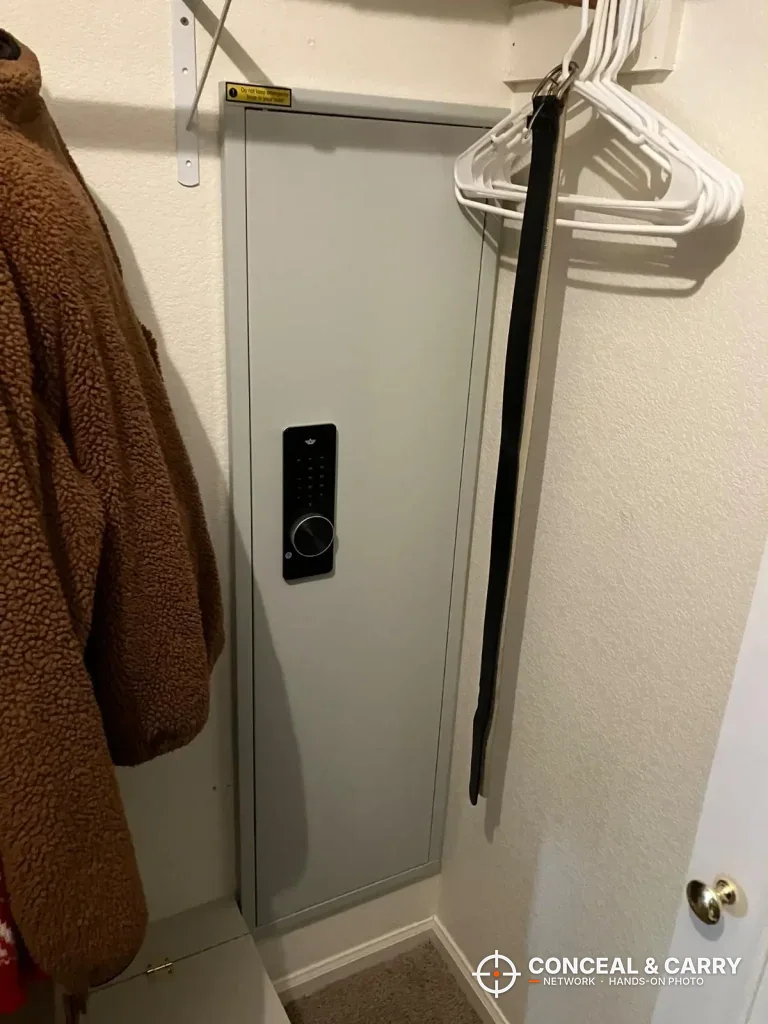
The seller lists the ways in. You can use a fingerprint or a password, and either one is followed by turning a knob. There’s also an emergency key, again with the knob, meant for the first time you open it, a forgotten code or a dead battery. The listing mentions a fourth method too, but the description cuts off before it says what that is, so confirm it on the page before you count on it.
That knob step matters. The electronics release the lock, but your hand still has to turn the knob and swing the door. Omethey doesn’t say how many prints the reader holds, so if two or three adults need in, ask before you buy. Whatever the number, enroll more than one finger, and enroll your main finger a few times at slightly different angles. Wet, cold or cut fingers give any reader trouble. I tell students to practice opening a safe the way they practice a draw: slow and right first, then smooth.
BACKUP KEY:
Two emergency keys come in the box. My rule in class never changes: the keys do not live next to the safe, and they never live where a child can find them. One goes on your key ring, the other in a second locked spot or with somebody you trust.
On an in-wall safe this goes double. If the battery dies and you can’t find a key, you can’t carry the box down to a locksmith. It’s part of your house now.
ALARMS:
Here’s where Omethey adds something a lot of budget safes skip. The seller describes two alarms. A vibration alarm goes off if the safe is shaken or moved, and an input-error alarm sounds after three wrong password attempts. Omethey says the buzzer runs for 30 seconds. There’s also a silent mode that turns the button beeps off, which is a courtesy on a bedroom closet wall.
As an old lawman, I like anything that makes noise when somebody’s working on it. A burglar wants quiet. Thirty seconds of buzzing in a closet won’t bring a patrol car, but it may send a nosy teenager or a thief looking for easier work. The listing doesn’t say how silent mode affects the alarms, so check the manual before you switch it on.
INSIDE ROOM:
Omethey lists the outside at 15.74 inches wide, 53.15 inches tall and 5.12 inches deep. What it doesn’t list is the inside size, and that’s the number you need. A steel box gives up part of every measurement to its own walls and door.
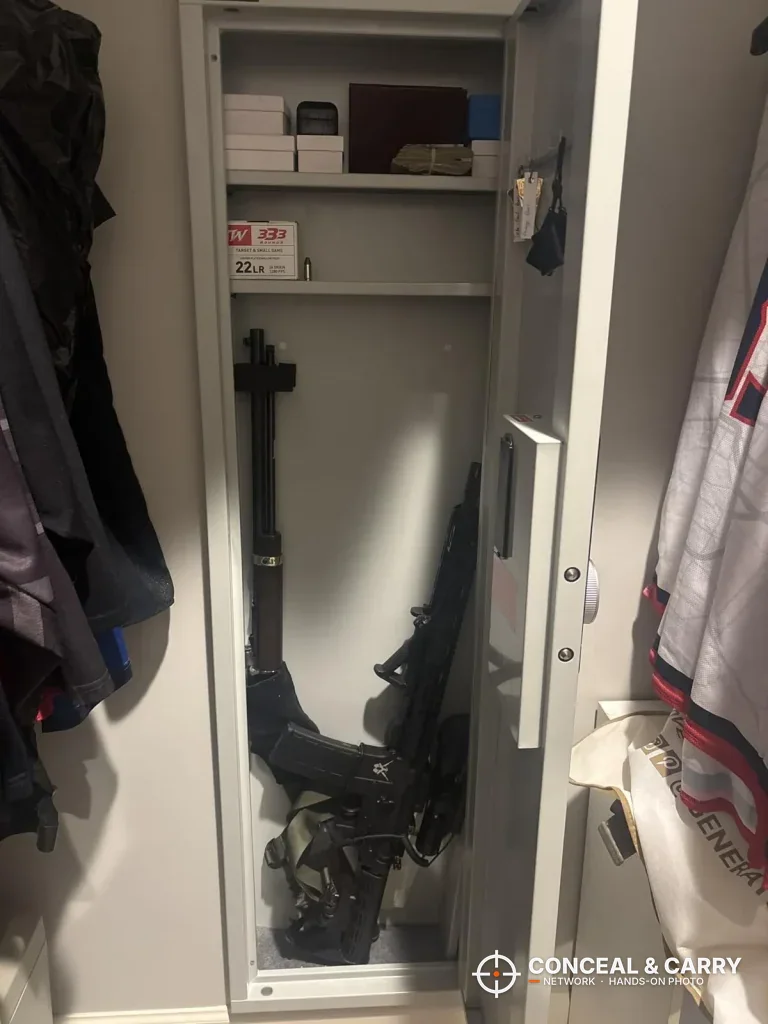
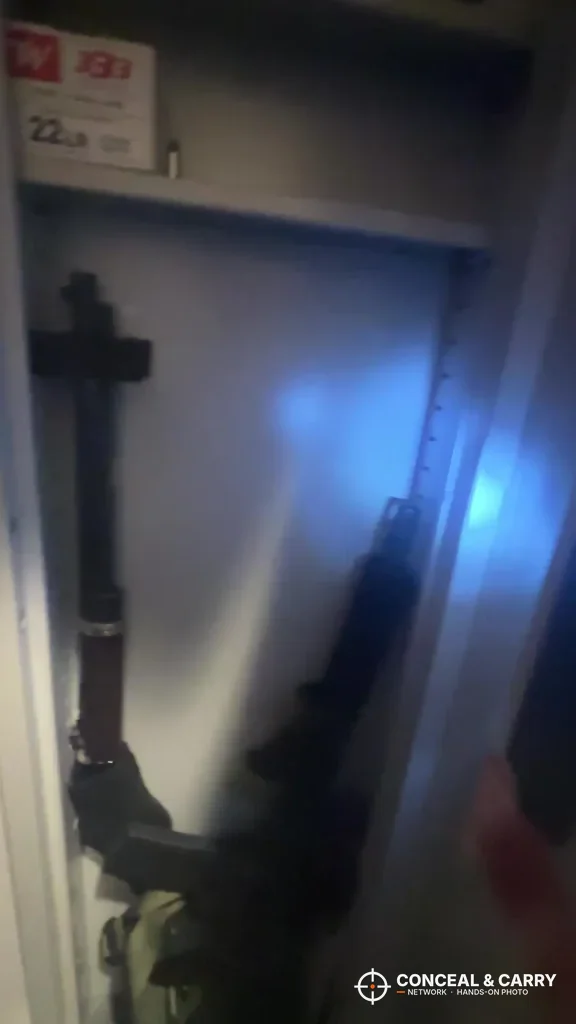
In the photos you can see long guns standing in the lower section, with shelves above holding boxes and small items. The seller says it can hold documents, passports, jewelry, cash, medicines, heirlooms, pistols, rifles and shotguns. That’s a long list for a cabinet about five inches deep. A slim carbine or a shotgun is one thing. A scoped hunting rifle or a gun with a fat stock needs measuring first.
I’d get the inside height, width and depth from the seller and hold them up against your longest and widest gun, optic included. Omethey also lists a key hook and an LED light inside, and a light is welcome in a dark closet.
SHELVES & RACK:
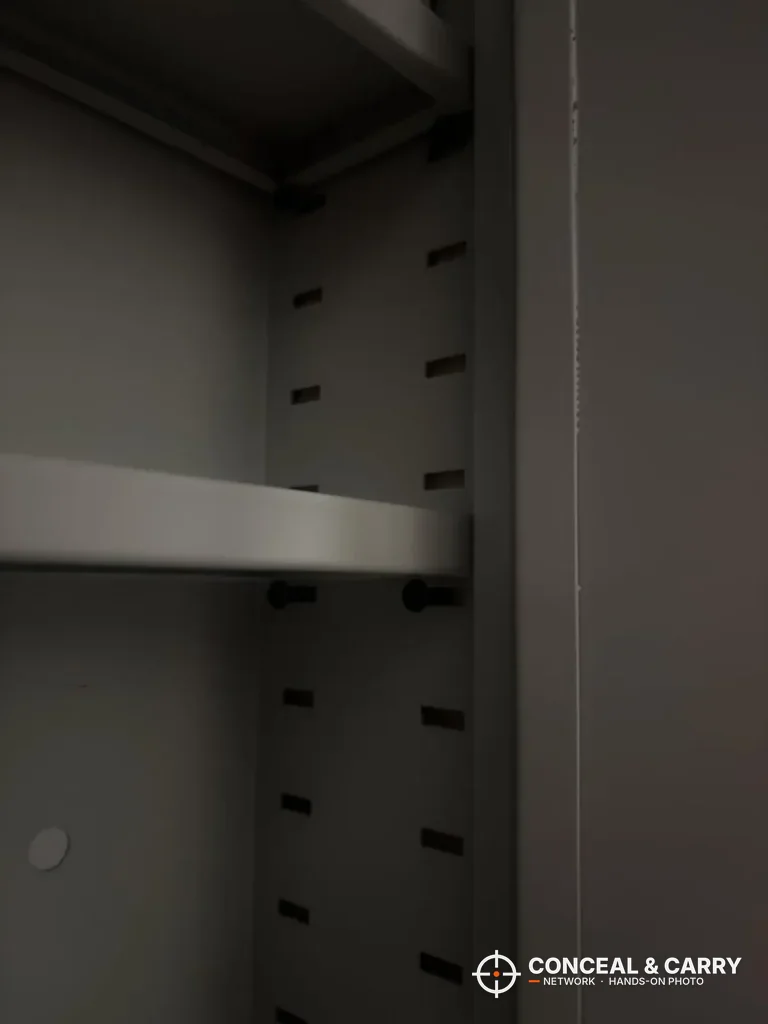
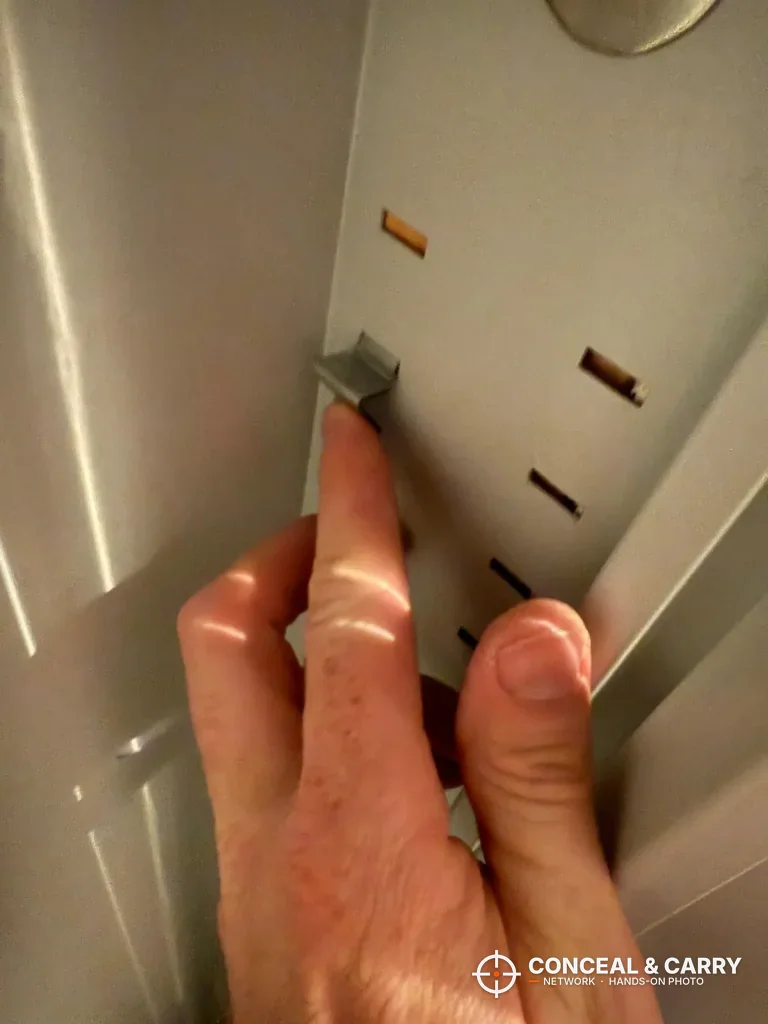
The listing calls for three adjustable shelves, and the close-ups show how they move. Rows of slots run up the side walls, and a shelf clip hooks into whichever slot puts the shelf where you want it. That lets you set the top for papers and valuables and leave the bottom open for long guns.
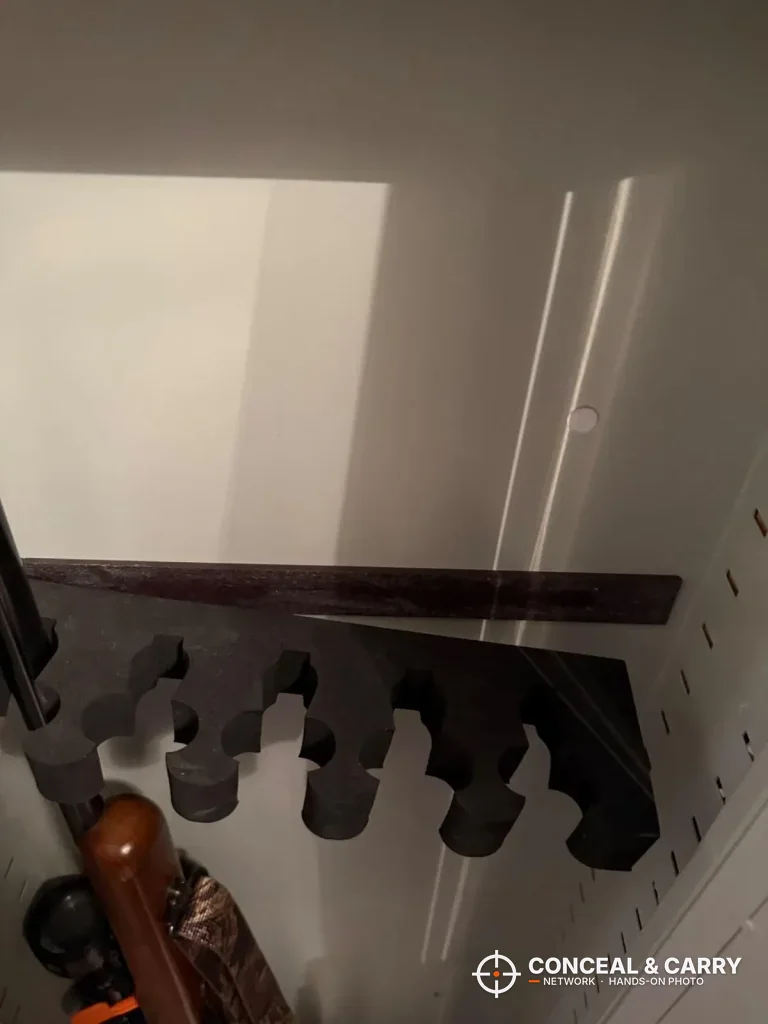
In the photos you can also see a notched rack with foam cradles to keep long guns standing apart. The listing mentions a magnetic gun support but doesn’t explain it, so check what ships with yours. Mind your ammunition storage too, because the rules vary by state.
DOOR & BOLTS:
Omethey is more specific here than most sellers in this price band. It lists four solid locking bolts on three sides, an all-metal integrated door panel, alloy steel with a powder-coat finish, and a weight of 41 pounds. Bolts on three sides are what I want to see, because a door held on one edge is an easy pry. And with the whole cabinet set inside the wall, a thief can’t tuck it under his arm the way he could a nightstand box.
Now the cautions. There’s no steel gauge listed and no third-party attack rating, so the seller’s line about resisting hand and power tools is a claim, not a test result. The listing also uses the word fireproof, and mentions waterproofing in places, but gives no fire rating, temperature, time or test standard. I’d keep the originals of anything important somewhere else. This is a hidden gun cabinet, not a fire safe.
MOUNTING:
The whole idea depends on your wall. Omethey says it fits between studs on 16-inch centers and includes eight expansion screws. Plenty of houses have other spacing, and walls hide wiring, plumbing and ductwork. Find your studs and check what’s in that bay before you buy, not after. Installing it means cutting your wall, so renters should read the lease first, and if you’re not handy with drywall, hire somebody who is. Follow the manual.
Pick the spot with care. A hidden safe only stays hidden if nobody knows where to look, so a closet wall, the space behind a door or a spot partly covered by furniture all make sense. Keep the keypad away from bathroom steam and out of a small child’s reach. North Carolina’s safe-storage law (G.S. 14-315.1) can put you in court if a child gets hold of a loaded gun you left within reach and something happens with it. Other states have their own versions.
POWER:
The safe is electronic, and Omethey packs an emergency battery box in with the two keys. The listing doesn’t give the normal battery type, how many it takes or how long they last, so look that up in the manual. Test the emergency battery box and both keys the day you set it up. Then put a reminder on your phone to check the batteries on the first of every month. A portable box with a dead battery is a nuisance. A safe built into your wall with a dead battery and a lost key is a carpentry job.
WHAT TO CHECK BEFORE YOU BUY:
Where it earns its keep: The Omethey is well-built with good attention to detail, fits neatly between wall studs, installs easily, and the electronic lock works reliably once set up.
Where it falls short: It is a thin-metal locking cabinet, not a true safe, and not fireproof despite the marketing. The fingerprint reader and keypad can misread and sometimes trigger the alarm, and the body may sit proud of a standard stud bay.
Who it’s for: A hidden in-wall spot for a shotgun or a few pistols, understood as a locking cabinet rather than a fireproof vault. Not for safe-level security or fire protection.
WHAT TO WATCH:
Three things. Your wall has to match the 16-inch stud spacing and be clear inside. The inside size isn’t listed, and at about five inches deep on the outside, bulky or scoped guns may not fit. And there’s no fire rating, whatever the listing wording says.
WHO SHOULD BUY IT:
Buy it if you own your home, you want a few long guns, a handgun and some papers out of sight in a closet, and you want to stay in the $100 to $200 range where it sat at the time of writing. Skip it if you rent, if your walls aren’t framed on 16-inch centers, or if you need a rated fire safe. A bolt-down cabinet or a heavier freestanding safe is the better answer there.
SPECS AT A GLANCE:
| Spec | What Omethey lists |
|---|---|
| Outside size | 5.12″ deep x 15.74″ wide x 53.15″ high |
| Fit | Between studs on 16-inch centers |
| Ways in | Fingerprint, password, emergency key (each with a turn knob), plus a fourth method |
| Body | Alloy steel, powder coat (no gauge listed) |
| Locking | 4 solid bolts on three sides, all-metal door panel |
| Interior | 3 adjustable shelves, magnetic gun support, key hook, LED light |
| Alarms | Vibration alarm, wrong-password alarm, silent mode |
| Weight | 41 lb |
| In the box | 2 emergency keys, emergency battery box, manual, 8 expansion screws |
| Fire rating, inside size | Not listed |
PROS & CONS:
Pros
- Hides between the studs with only the door showing
- Four locking bolts on three sides and an all-metal door
- Fingerprint, password and key, plus vibration and wrong-code alarms
- Three adjustable shelves for mixed storage
Cons
- No inside dimensions, steel gauge or fire rating listed
- Needs 16-inch stud spacing and a wall you’re allowed to cut
- About five inches deep, so bulky or scoped guns may not fit
$199.99 on Amazon (as of Oct 31, 2026, 12:05 AM EDT – details)
Comparing hidden options? See my best in-wall gun safe picks.
Hands-on test record
Protocol prepared for Chris. Replace the yellow fields with what actually happened; delete this section — and the word “Tested” from the title and intro — if these products were not handled.
| Who tested | Chris Raper, NRA-certified instructor |
|---|---|
| Dates | October 31, 2026 |
| Products on this page | Omethey In-Wall Biometric Safe |
| Protocol (plan) | Check stud spacing and wall depth, install the safe into the framing as the manual directs, then open it repeatedly by fingerprint, password and key, including in a dark room. Trigger both alarms on purpose and load your own handguns and long guns to check fit. |
| To measure | Record dark-room open time per method, failed fingerprint reads, alarm behavior, and the usable interior versus the listed size. |
| What failed or disappointed | |
| Photos from the tester | Our community |
Omethey In-Wall Biometric Safe FAQ
Does the Omethey in-wall safe fit between standard studs?
Omethey says it fits between studs on 16-inch centers, and lists the outside at 15.74 inches wide and 5.12 inches deep. Check your own stud spacing and look for wiring, pipes or ducts in that wall before you buy, since installing it means cutting into the wall.
How do you open the Omethey in-wall biometric safe?
The listing describes a fingerprint plus a turn of the knob, a password plus the knob, and an emergency key plus the knob. A fourth method is mentioned but not spelled out, so check the listing. Practice every method after setup so none of them is new when it counts.
Is the Omethey in-wall safe fireproof?
The listing uses fireproof wording, but it gives no fire rating, temperature or time. Don’t count on it to protect papers in a house fire unless you find a published rating on the page or in the manual.
What alarms does the Omethey safe have?
The seller describes a vibration alarm when the safe is shaken or moved, and an alarm after three wrong password attempts, with a 30-second buzzer. A silent mode is also listed, so check in the manual how it affects the alarms.
What comes in the box?
The listing shows two emergency keys, an emergency battery box, a manual and eight expansion screws. Battery type and inside dimensions aren’t listed, so check the manual and the seller before you plan what goes in it.
Chris Raper
Chris Raper is the founder and lead reviewer of Conceal & Carry Network. A retired North Carolina law-enforcement officer with more than 40 years of service and a U.S. Air Force Security Police veteran, he founded Concealed Handgun Carry, Inc. in Elm City, NC in 2006 and has taught the state-approved NC Concealed Handgun Carry class there ever since. He is an NC Department of Justice certified Firearms Safety Instructor, an NRA Pistol, Rifle and Shotgun Instructor, an NRA Range Safety Officer and a graduate of Massad Ayoob's Lethal Force Institute. He reviews the carry guns, holsters, safes and sight tools his students ask about every week.