 Chris Raper — Retired North Carolina law enforcement (40+ years) · U.S. Air Force Security Police · NRA-certified Pistol, Rifle & Shotgun Instructor · NC DOJ-certified Concealed Carry Instructor · Founder, Concealed Handgun Carry, Inc. (Elm City, NC, 2006)
 Bill Wilson — Founder, Wilson Combat · 1911 gunsmith since 1974 (manufacturer — disclosed) · Review date: October 31, 2026
In addition to my own research and what my students bring into the Concealed Handgun Carry class every week, this guide was reviewed by Bill Wilson of Wilson Combat, whose opinion appears below. The method line at the end of the article says exactly how this guide was built.
You can remove a dovetailed pistol rear sight without a sight pusher. Gunsmiths did it for a century with a brass punch, a bench block and a small hammer, and for a plain steel sight on a slide you are not precious about, it still works. The method is not hard. What is hard is doing it without the punch skidding across the slide, which is the one mistake that turns a free job into a refinish. Here is the right way, the direction to drift, and the three situations where you should stop and use a pusher instead.
What you need
- A brass or nylon punch, 1/8 to 3/16 inch. Never a steel punch on a sight.
- A bench block with a slot for the slide, or a padded vise. The Wheeler Universal Bench Block is the common one.
- A small hammer, 4 to 8 ounces.
- Painter’s tape, degreaser, an Allen key for any set screw.
Which direction to drift
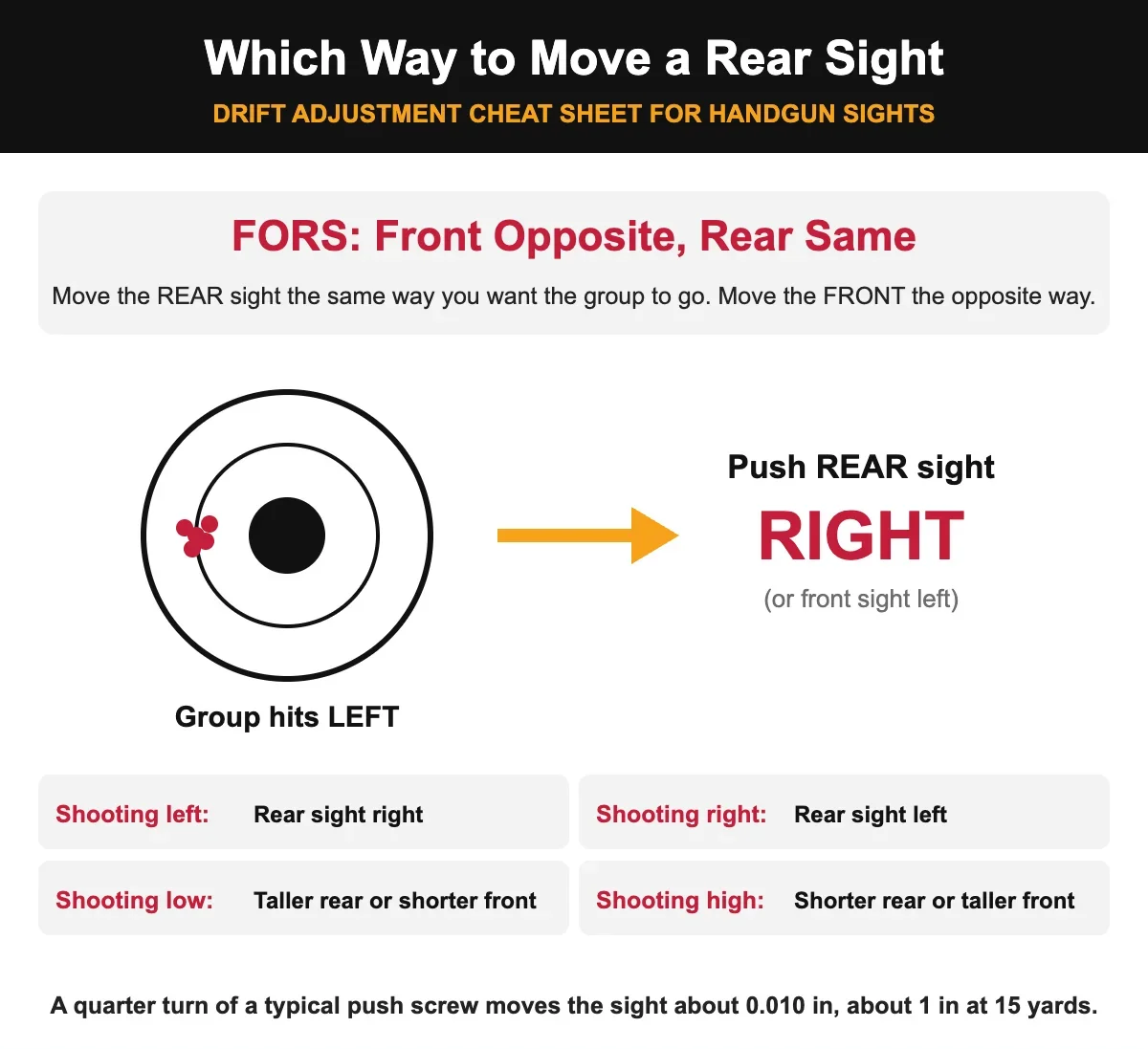
On most modern pistols the rear sight comes out left to right as viewed from the rear (shooter’s view), and the new one goes in right to left. Glock, M&P, Sig and XD follow this. Some 1911s, CZs and older designs have tapered dovetails cut the other way. Look for a factory witness mark, or measure the dovetail opening on each side with calipers; drift toward the wider side. Driving a tapered dovetail the wrong way jams the sight and chews the dovetail.
The method
- Clear and field strip. Work with the bare slide.
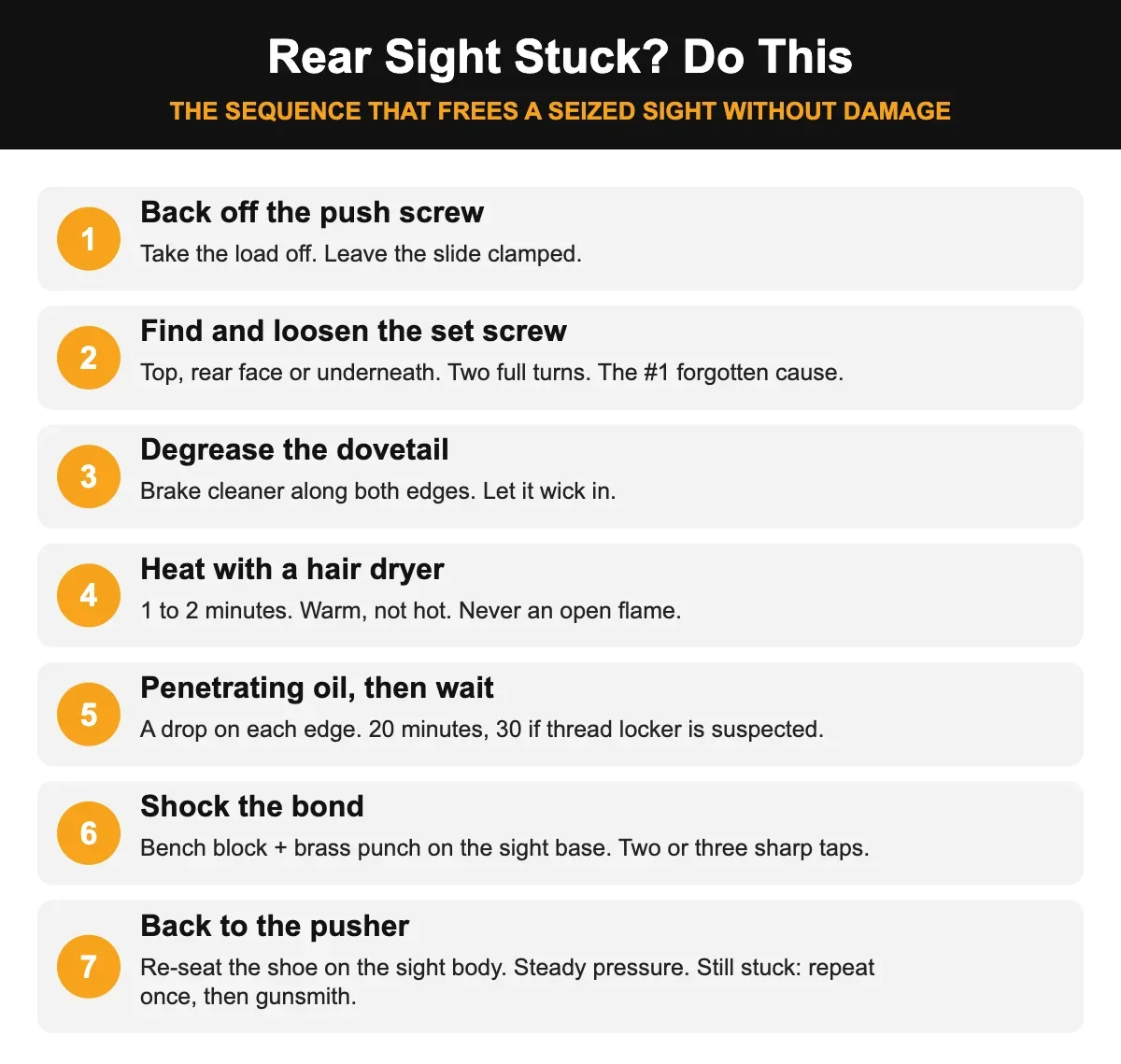
- Loosen the set screw. Novak-style and most aftermarket rear sights have one. Two full turns out. Skipping this is why punches bounce and dovetails get gouged.
- Degrease the dovetail. Brake cleaner on a patch along both edges. Factory grease and carbon are glue.
- Tape the slide. Two layers of painter’s tape over the slide top on both sides of the sight. This is what saves the finish when the punch slips.
- Support the slide. Set it in the bench block slot so the slide is dead flat and cannot roll, with the sight hanging over the edge of the block on the exit side. If it can rock, the punch will skid.
- Place the punch on the sight base. The base is the thick part sitting in the dovetail. Never on the blade and never on a tritium housing. Hold the punch square to the sight and perpendicular to the slide.
- Tap, do not swing. Firm, controlled taps. The first movement is the hardest; after it breaks free it moves with light taps. Re-seat the punch after every tap.
- Install the new sight. Start it by hand from the install side, tap it to center using a witness mark, snug the set screw with blue thread locker, re-zero at the range.
Watch: “How to remove or install fixed gun sights without using a sight pusher” by tumofo on YouTube.
If it will not move
Do not hit harder. Warm the slide with a hair dryer for a minute, put penetrating oil on both dovetail edges, wait twenty minutes, tap again. If it still will not move after that, this is one of the three “stop” situations below.
Three times to stop and use a sight pusher
- Tritium night sights you want to keep. A punch on a tritium housing cracks the vial. A pusher’s shoe spreads the force across the sight body.
- M&P 2.0, Sig and other factory-tight sights. These need more force than a brass punch delivers cleanly. You will mushroom the punch and mark the slide before the sight moves.
- A finish you care about. Cerakote, bluing, nickel. One skid is a refinish. The tool costs less than the refinish.
Our picks for each budget are in best sight pusher tools, and is a sight pusher worth it walks through the break-even. If you do decide on a tool, how to use a sight pusher is the companion to this guide.
Watch: “Tech Tip: How To Install Pistol Sights the Old School Way” by Brownells, Inc. on YouTube.
Front sights
Glock, M&P and most Sig front sights are not dovetailed; they are held by a screw or hex nut from under the slide and come off with a 3/16-inch nut driver. Do not drift them. Dovetailed front sights on 1911s and CZs can be drifted with the same punch method, with extra care because the slide narrows toward the muzzle and the support is less stable.
FAQ
Can I use a steel punch?
Not on the sight. Steel on steel marks the sight and the slide. Brass or nylon only.
Which way do I drift a Glock rear sight?
Out left to right as viewed from the rear, in right to left. Glock factory polymer sights often crack during removal; if you are replacing them it does not matter.
Is the punch method worse for the slide than a sight pusher?
Only when it slips. Done carefully with tape and a stable block it leaves no marks. The pusher removes the slip risk, which is why it is worth it for finishes and sights you care about.
We may earn a commission from qualifying purchases made through links on this page, at no extra cost to you.
Chris Raper
Chris Raper is the founder and lead reviewer of Conceal & Carry Network. A retired North Carolina law-enforcement officer with more than 40 years of service and a U.S. Air Force Security Police veteran, he founded Concealed Handgun Carry, Inc. in Elm City, NC in 2006 and has taught the state-approved NC Concealed Handgun Carry class there ever since. He is an NC Department of Justice certified Firearms Safety Instructor, an NRA Pistol, Rifle and Shotgun Instructor, an NRA Range Safety Officer and a graduate of Massad Ayoob's Lethal Force Institute. He reviews the carry guns, holsters, safes and sight tools his students ask about every week.
1 thought on “How to Remove a Rear Sight Without a Sight Pusher (Punch and Bench Block Method) — Reviewed by Chris Raper, Expert-Reviewed by Bill Wilson”
Comments are closed.