
 Massad Ayoob — Founder, Massad Ayoob Group · Retired Police Captain · Expert Witness on use of force · Review date: October 31, 2026
 Chris Raper — Retired North Carolina law enforcement (40+ years) · U.S. Air Force Security Police · NRA-certified Pistol, Rifle & Shotgun Instructor · NC DOJ-certified Concealed Carry Instructor · Founder, Concealed Handgun Carry, Inc. (Elm City, NC, 2006)
In addition to my own research and what my students bring into the Concealed Handgun Carry class every week, this guide was reviewed by Massad Ayoob of Massad Ayoob Group, whose opinion appears below. [Keep only if true — Chris: I handled the product(s) on this page myself. Details are in the test record at the end.] The method line at the end of the article says exactly how this guide was built.
When a student asks me what happens if the fancy lock on his gun box quits, I tell him that’s the right question, and he should ask it before he buys, not after. The Hornady RAPiD Safe Keypad Vault answers it with three ways in: an RFID tag, a code you set yourself and a plain mechanical key.
My verdict: it’s a 15-pound steel box with more inside height than most bedside lockboxes, and it’s built to be bolted down. It suits a household that wants speed plus a fallback. Skip it if you need fire protection or something light to carry around.
FYI, prices and ratings are accurate as of time of writing.
Specs from the manufacturer listing · owner feedback summarized and labelled · hands-on test notes being added · How we review
Hornady RAPiD Safe Keypad Vault – Best Bolt-Down RFID Handgun Safe Under $200
HIGHLIGHT:
RFID tag, a programmed code and a mechanical key on a 14-gauge steel box you can bolt to a shelf or a floor.
OUT OF THE BOX:
Hornady’s listing puts three things in the box with the safe: an RFID watchband tag, an RFID adhesive decal and two circular barrel keys. The listing title mentions two tags, and the watchband plus the decal make two, so that adds up. The model is listed as Item 97436.
What I don’t see on that list is mounting hardware. The listing says the housing is predrilled for bolting, but it doesn’t say bolts come with it. Plan on buying fasteners made for whatever you’re anchoring to.
Before anything goes inside, sit down at the kitchen table with the lid open. Program the code, set up both tags and try every way in several times. A lock you’ve only opened once is a lock you don’t know yet.
THREE WAYS IN:
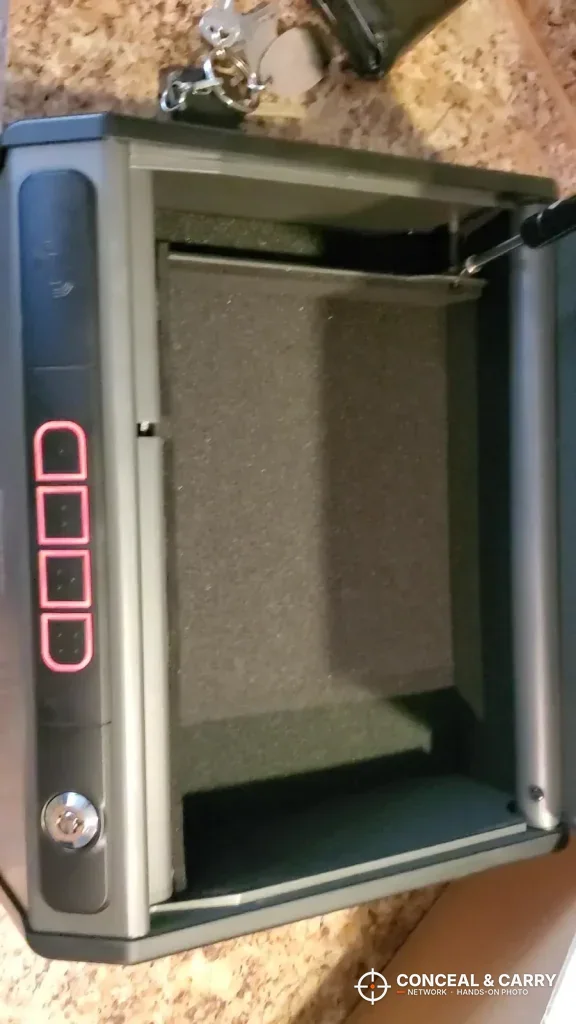
The selling point is the trio. Hornady describes an RFID reader, a user-programmed access code and a mechanical key, and says they can be selectively programmed, including with other Hornady safes you may own. In the photo up top you can see the lid open, a row of four lit buttons along the edge and the round key lock just below them.
I like layered access on a bedside box because each method covers the other’s weak spot. The tag is quick. The code is there when the tag is across the room. The key is there when the electronics aren’t.
RFID TAGS:
RFID means you bring the tag close and the reader does the rest. No buttons to find in the dark, no code to remember with your heart going. The watchband tag goes on your wrist, and the adhesive decal can go on something you carry every day, like a phone case or a wallet.
Here’s the catch I point out in every class. A tag is a key. If it lives on the nightstand next to the safe, anybody in the house can open that box, including a curious twelve-year-old. Wear it, carry it or lock it up. If one goes missing, the manual is where you’ll find how to reprogram the tags.
CODE & BACKUP KEY:
The code covers a lost tag, and it’s the way in for another adult in the house who doesn’t wear one. Pick something that isn’t a birthday or a street address. Kids know those numbers better than you think.
Now the key. I tell every class the same thing: the backup key does not live in the same drawer as the safe, and it never lives where a child can find it. Put one on your key ring and the other in a second locked spot. A steel box with the key sitting beside it is just a heavy box.
BUILD & STEEL:
Hornady says the body is 14-gauge steel with a thick steel lid, and calls it tamper proof. That last part is a marketing word, not a rating. The seller also says the RAPiD line exceeds ASTM International standards for child and pry resistance, lock strength, and drop, pick and saw tests. That’s the brand’s claim. If you need the paperwork behind it, look for the documentation on Hornady’s site or in the manual.
Steel does put this a step ahead of the plastic lockboxes when it comes to prying. As an old lawman, my first thought on any box like this is the burglar with a screwdriver and five minutes. Steel slows him down. Bolts keep him from carrying the whole problem out to his car.
INSIDE ROOM:
Hornady lists the inside at 10.6 by 7.8 by 3.3 inches. That 3.3 inches of height is the number I’d look at first. A lot of slim bedside boxes stop somewhere around 1.75 to 2 inches inside, and that’s where guns with lights and red dots start to have trouble closing.
The seller says it fits most full-size handguns plus valuables. I’d treat that as a starting point, not a promise. Measure your gun at its tallest, longest and widest points, optic, light and extended magazine included, and check all three numbers against the box.
The listing doesn’t mention foam, a lining or a removable shelf. In the photo the floor looks to have a gray lining, but go by what’s in your box when it arrives. And keep the gun on top. A pile of watches and papers sitting on the pistol turns a quick-access safe into a slow one.
MOUNTING:
Hornady lists it as freestanding or tabletop, and says the housing is predrilled so you can bolt it to a secure structure with appropriate fasteners. Do that. At 15 pounds it’s heavy enough to feel solid on a shelf and still light enough for a man to tuck under his arm on the way out the back door.
The outside runs 13.1 by 11.0 by 3.9 inches, so it needs a deep shelf, a wide drawer or a spot on a closet floor. Check that the lid has room to swing all the way open where you put it. Good spots are the inside of a nightstand, a closet shelf or the floor of a cabinet, bolted with hardware that suits the surface.
If you have children in the house, this part isn’t optional. North Carolina’s safe-storage law (G.S. 14-315.1) can put you in court if a child gets hold of a loaded gun you left within reach and something happens with it. Other states have their own versions.
POWER:
This is the hole in the listing. The RFID reader and the keypad are electronic, so something powers them, but the listing doesn’t say whether it’s batteries, how many, or whether it can run off an adapter. I won’t guess. Check the manual, the product images and the Q&A on the Amazon page before you order.
Whatever it turns out to be, put a reminder on your phone to check it on the first of every month. And keep that key where you can get to it. The key is what keeps a dead battery from locking you out of your own gun at 3 a.m.
WHAT TO CHECK BEFORE YOU BUY:
Where it earns its keep: The Hornady RAPiD Keypad Vault is a heavy-duty box with dependable programming and operation, plenty of interior room for EDC items, and compatibility with other Hornady RFID products.
Where it falls short: The vault can be forced open quickly with a hatchet or pry bar, the keypad buttons feel cheap, and no security cable is included, with no attachment point to add one. Locking mechanisms can also fail early on individual units.
Who it’s for: Someone who wants a Hornady-brand vault with RFID, keypad and key access for EDC storage. Look elsewhere if real pry-resistance or a built-in cable anchor is a requirement.
WHAT TO WATCH:
Three things. The power source isn’t stated. There’s no fire rating, and the spec table says it isn’t water resistant, so don’t keep passports or deeds in it expecting them to come through a fire or a flood. And the listing had few reviews at the time of writing, so there’s not much owner feedback to lean on yet. Read the newest comments slowly, and look for what people say about the tag reading on the first try and how easy the code is to change.
WHO SHOULD BUY IT:
Buy it if you want a steel box beside the bed or on a closet shelf for one full-size handgun, you like having a tag, a code and a key, and you’ll bolt it down. At the time of writing it sat in the $100 to $200 range. Skip it if you want something light to travel with, or a container rated for fire. If your spot is tight, a smaller box will serve you better.
SPECS AT A GLANCE:
| Spec | What Hornady lists |
|---|---|
| Model | Item 97436 |
| Outside size | 13.1 x 11.0 x 3.9 inches |
| Inside size | 10.6 x 7.8 x 3.3 inches |
| Ways in | RFID tag, programmed code, mechanical key |
| Body | 14-gauge alloy steel, thick steel lid (per seller) |
| Weight | 15 lb |
| Mounting | Freestanding or tabletop; predrilled for bolting |
| Water resistance | Not water resistant |
| In the box | RFID watchband tag, RFID adhesive decal, two circular barrel keys |
| Not listed | Power source, fire rating |
PROS & CONS:
Pros
- Three ways in: RFID tag, code and key
- 3.3 inches of inside height, more than slim lockboxes
- Steel body and steel lid, per Hornady
- Predrilled so it can be bolted down
Cons
- Power source not stated on the listing
- No fire rating, and not water resistant
- Mounting hardware doesn’t appear to be included
$145.43 on Amazon (as of Oct 31, 2026, 12:05 AM EDT – details)
Only need a tag and a key in a flatter box? See my Hornady RAPiD Safe RFID review.
Hands-on test record
Protocol prepared for Chris. Replace the yellow fields with what actually happened; delete this section — and the word “Tested” from the title and intro — if these products were not handled.
| Who tested | Chris Raper, NRA-certified instructor |
|---|---|
| Dates | October 31, 2026 |
| Products on this page | Hornady RAPiD Safe Keypad Vault |
| Protocol (plan) | Bolt the vault to a shelf or floor and open it by RFID, code and key from a seated or lying position in the dark; repeat the code with gloves or wet hands; confirm the key opens it with the batteries removed. |
| To measure | Record open time per entry method, interior height versus spec, and whether the RFID reads through a sleeve or a pocket. |
| What failed or disappointed | |
| Photos from the tester | Our community |
Hornady RAPiD Safe Keypad Vault FAQ
How do you open the Hornady RAPiD Safe Keypad Vault?
Hornady lists three ways: an RFID tag (a watchband tag and an adhesive decal come in the box), a code you program yourself, and a mechanical key. Two circular barrel keys are included, and the key is your way in if the electronics stop responding.
What fits inside the Keypad Vault?
The listing gives the inside as 10.6 x 7.8 x 3.3 inches and says it fits most full-size handguns and valuables. Measure your gun with any light, optic or extended magazine against those numbers before you order.
Can the Keypad Vault be bolted down?
Yes. Hornady describes a predrilled housing and says to bolt it to a secure structure with appropriate fasteners. Mounting hardware doesn’t appear to be included, so pick fasteners that suit your shelf, cabinet or floor.
What powers the keypad and RFID reader?
The listing doesn’t say. Check the manual, the product images and the Q&A on the Amazon page before you order, and check the electronics on a schedule. The mechanical key is the fallback.
Is it fire rated or waterproof?
No fire rating is listed, and the spec table says it isn’t water resistant. Use it to keep a handgun away from children and thieves, and keep important papers in a separate rated container.
Chris Raper
Chris Raper is the founder and lead reviewer of Conceal & Carry Network. A retired North Carolina law-enforcement officer with more than 40 years of service and a U.S. Air Force Security Police veteran, he founded Concealed Handgun Carry, Inc. in Elm City, NC in 2006 and has taught the state-approved NC Concealed Handgun Carry class there ever since. He is an NC Department of Justice certified Firearms Safety Instructor, an NRA Pistol, Rifle and Shotgun Instructor, an NRA Range Safety Officer and a graduate of Massad Ayoob's Lethal Force Institute. He reviews the carry guns, holsters, safes and sight tools his students ask about every week.
2 thoughts on “Hornady RAPiD Keypad Vault Review: A 40-Year Lawman’s Take On RFID, Code And Key — Reviewed by Massad Ayoob, Tested by Chris Raper”
Comments are closed.