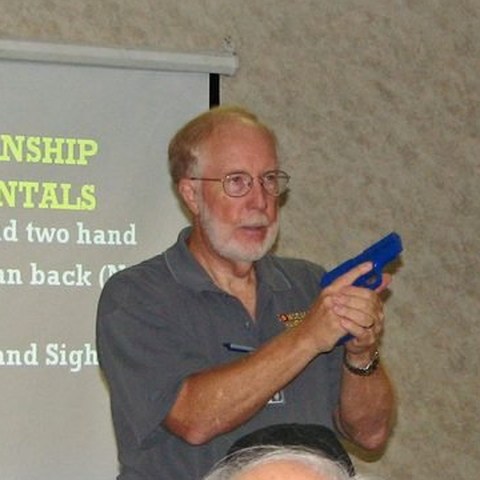
 Chris Raper — Retired North Carolina law enforcement (40+ years) · U.S. Air Force Security Police · NRA-certified Pistol, Rifle & Shotgun Instructor · NC DOJ-certified Concealed Carry Instructor · Founder, Concealed Handgun Carry, Inc. (Elm City, NC, 2006)
This guide draws on my own research and what my students bring into the Concealed Handgun Carry class every week. The method line at the end of the article says exactly how this guide was built.
Quick answer
To store guns safely with kids in the house, keep every gun either on your body or locked. Use a bolted-down quick-access safe for the home-defense gun, a full-size safe or a locked cabinet for everything else, and lock ammunition separately for long-term storage. Keep keys and codes away from children, teach kids what to do if they find a gun, and check your state’s child-access law, which can make you criminally liable if a child gets to an unsecured firearm.
The question I get most from parents in my North Carolina concealed handgun class is some version of “where do I keep the gun at night with the kids in the house?” It is the right question. A gun hidden on a closet shelf or in a sock drawer is not stored; it is waiting to be found. Children are curious, they are better at finding things than adults think, and teenagers can open almost anything they are motivated to open.
This guide covers what the law expects, how to store each gun depending on how you use it, how to choose a lock or safe, and what to teach children at different ages. I am a certified firearms instructor, not a lawyer; storage laws differ from state to state and change, so read your own state’s statute before you rely on any of this.
What the law says about storing guns around children
FEDERAL LAW:
There is no general federal law that tells you how to store a gun at home. What federal law does require, under 18 U.S.C. 922(z), is that licensed dealers provide a secure gun storage or safety device, such as a lock, when they sell or transfer a handgun to an unlicensed buyer. That is why most new handguns come with a cable lock in the box.
STATE CHILD-ACCESS PREVENTION LAWS:
Many states have child-access prevention laws, often called CAP laws, that make an adult criminally liable when a child gets to a firearm that was not stored securely. A KFF review of state laws for 2026 counts 26 states with such a law. They differ a great deal: some apply only after a child actually gets the gun, some when a child is likely to get it, and the age they protect ranges from under 14 to under 18. Look up your own state’s statute; a good starting point is the KFF state table.
NORTH CAROLINA:
North Carolina’s law is G.S. 14-315.1. It applies to anyone who lives in the same home as a minor (under 18) and owns or possesses a firearm. It is a Class 1 misdemeanor to leave a firearm in a condition where it can be fired, in a way you knew or should have known an unsupervised minor could get to it, if the minor gets it without permission and then carries it onto school property, shows it in a careless, angry or threatening way in public, hurts or kills someone with it other than in self-defense, or uses it in a crime. The law does not stop you from carrying the gun on your body or keeping it close enough to use as quickly as if you were carrying it, and it does not apply if the minor got the gun through someone’s unlawful entry. Our North Carolina concealed carry FAQ covers related rules.
The legal minimum is not the goal. The goal is that no child in your home, and no child visiting it, can get to a gun.
How to store each gun, by how you use it
THE GUN ON YOUR BODY:
A gun in a quality holster on your belt is under your control. The risk comes at the moments it comes off: when you change clothes, take a shower or go to bed. Decide now where it goes at each of those moments, and make that place a lock, not a dresser top. Our holster safety rules cover safe holstering and unholstering.
THE HOME-DEFENSE GUN:
This is where most families get it wrong, because the gun has to be fast for you and impossible for a child. That is the job of a quick-access safe: a small steel box that opens by keypad, RFID tag, fingerprint or mechanical push-buttons in a few seconds. Bolt it to the nightstand, a shelf or the floor so it cannot be carried off, and practice opening it in the dark. Compare options in our best quick-access gun safe, best nightstand gun safe and best handgun safe guides, and follow how to bolt down a gun safe.
GUNS YOU ARE NOT USING:
Hunting rifles, shotguns and spare handguns belong in a full-size gun safe or a locked steel cabinet, unloaded. If you do not own a safe yet, a cable lock through the open action plus a locked closet is a stopgap, not a solution. For long-term storage, lock the ammunition in a separate container. See our best gun safe guide and what size gun safe you need.
THE GUN IN THE CAR:
Vehicles are a common source of stolen guns, and a car in the driveway is easy for a teenager to get into. If the gun must stay in the vehicle, use a lockbox cabled or bolted to the frame. Our best car gun safe guide covers the options.
WHEN CHILDREN VISIT, AND WHEN YOURS VISIT OTHERS:
Before grandchildren or your kids’ friends come over, walk the house and make sure every gun is locked, including the one you usually keep on you. When your children go to someone else’s home, it is reasonable to ask, calmly, whether there are guns in the house and how they are stored.
Choosing a lock or safe
| Device | Good for | Watch out for |
|---|---|---|
| Cable lock | Making an unloaded gun inoperable; often free | Gun must be unloaded; does not stop theft |
| Lockbox | Travel and the car; keeping one handgun locked | Thin steel; must be cabled or bolted |
| Quick-access safe | The home-defense handgun | Code, key or tag security; bolt it down |
| Full-size safe or steel cabinet | Long guns and guns not in use | Bolt it down; keep the combination private |
FREE CABLE LOCKS:
Through Project ChildSafe, the National Shooting Sports Foundation’s safety program, many local law enforcement agencies hand out free kits with a cable-style gun lock. The program reports distributing more than 42 million locks. Ask your sheriff’s office or police department.
BIOMETRIC SAFES:
A fingerprint reader can be fast, but in 2024 the Consumer Product Safety Commission announced recalls of several brands of biometric gun safes after reports that they could be opened by unauthorized users, including children. Read our biometric gun safe recall page and are biometric gun safes reliable before you buy one, and never enroll a child’s fingerprint.
KEYS AND CODES:
The backup key does not live in the same drawer as the safe, and it does not hang on the ring your teenager borrows. Do not use birthdays, addresses or anything a child could guess for a code, and change the code if you think it has been seen.
What to teach children, by age
YOUNG CHILDREN:
Young children cannot be trusted to remember a rule when they find something exciting, which is why storage comes first. Teach them anyway, in words they can repeat. The NRA’s Eddie Eagle GunSafe program uses a simple four-step message: stop, don’t touch, run away, and tell a grown-up. Practice it the way you would practice a fire drill.
SCHOOL-AGE CHILDREN:
Curiosity is the biggest risk at this age, and taking the mystery away helps. When you judge your child ready, show them the gun under your direct supervision, explain that it is not a toy, and let them ask questions. Repeat that if they ever see a gun at a friend’s house, they leave and tell you.
TEENAGERS:
Teenagers can learn the safety rules and, with you, safe shooting at a range. They can also defeat poor storage. Treat a teenager’s access as an adult-level security problem: locked means locked, and the code is not shared. If a teenager in your home is going through a hard time, consider storing the guns outside the home for a while, and know that the 988 Suicide & Crisis Lifeline is available by call or text.
Common storage mistakes
- Hiding instead of locking. Top shelves, sock drawers and under the mattress are the first places children look.
- An unbolted safe. A small safe that is not bolted down can be carried off and opened later.
- The key next to the lock. A key in the nightstand drawer under the safe is not security.
- The gun left in the car. A vehicle is easy to enter, for a thief or a curious teenager.
- Locking the gun but not the ammunition for guns in long-term storage.
- Assuming your child does not know where it is. Many children do.
A safe-storage checklist for parents
- Every gun in the house is on an adult’s body or locked. No exceptions for “just a minute.”
- The home-defense gun is in a quick-access safe bolted down, and you have practiced opening it in the dark.
- Guns not in use are unloaded in a safe or locked cabinet, with ammunition locked separately.
- Keys and codes are known only to the adults who need them.
- The car gun, if any, is in a cabled or bolted lockbox.
- Your children know the four steps if they find a gun.
- You have read your state’s child-access law.
Key takeaway: storing guns safely with kids means every gun is either on an adult’s body or locked, the defensive gun is in a bolted quick-access safe, and children are taught what to do if they ever find one.
Storing guns with kids FAQ
Is it illegal to leave a loaded gun where a child can reach it in North Carolina?
It can be. Under G.S. 14-315.1 it is a Class 1 misdemeanor if you leave a firearm that can be fired where an unsupervised minor could get it and the minor then misuses it in one of the ways the statute lists. Carrying the gun on your body is not covered.
Does federal law require me to lock up my gun?
There is no general federal home-storage requirement. Federal law requires licensed dealers to provide a storage or safety device with each handgun they sell to an unlicensed buyer.
Where can I get a free gun lock?
Many local police and sheriff’s offices give out free cable-lock kits through NSSF’s Project ChildSafe program.
Should I store ammunition separately from guns?
For guns in long-term storage, yes. For the home-defense handgun, keep it ready in a locked quick-access safe instead.
Is a biometric safe a good idea with kids in the house?
It can be, if it is a reputable model with a reliable sensor and a secure backup. Check the recall list, never enroll a child’s print, and keep the backup key secured.
Chris Raper
Chris Raper is the founder and lead reviewer of Conceal & Carry Network. A retired North Carolina law-enforcement officer with more than 40 years of service and a U.S. Air Force Security Police veteran, he founded Concealed Handgun Carry, Inc. in Elm City, NC in 2006 and has taught the state-approved NC Concealed Handgun Carry class there ever since. He is an NC Department of Justice certified Firearms Safety Instructor, an NRA Pistol, Rifle and Shotgun Instructor, an NRA Range Safety Officer and a graduate of Massad Ayoob's Lethal Force Institute. He reviews the carry guns, holsters, safes and sight tools his students ask about every week.