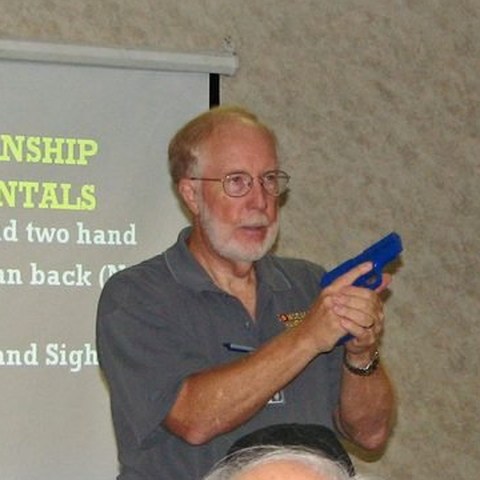
 Chris Raper — Retired North Carolina law enforcement (40+ years) · U.S. Air Force Security Police · NRA-certified Pistol, Rifle & Shotgun Instructor · NC DOJ-certified Concealed Carry Instructor · Founder, Concealed Handgun Carry, Inc. (Elm City, NC, 2006)
This guide draws on my own research and what my students bring into the Concealed Handgun Carry class every week. The method line at the end of the article says exactly how this guide was built.
Quick answer
During a concealed carry traffic stop: pull over safely, turn off the engine, turn on the dome light at night, lower the window and keep both hands on the steering wheel. Follow your state’s duty-to-inform law, which in some states means telling the officer at first contact that you have a permit and a handgun. Say where the gun is, do not reach for anything until the officer tells you to, and never touch the gun unless you are directed to.
I spent more than forty years in North Carolina law enforcement, and a good share of that time was spent walking up to the driver’s window of cars I had just stopped. Every officer approaches a car knowing they cannot see what is in the driver’s hands until they get there. A concealed carrier who understands that, and who makes the first thirty seconds calm and predictable, almost always has a short, uneventful stop.
This guide covers what “duty to inform” means, how the rules differ from state to state, a step-by-step routine for the stop itself, and the mistakes that turn a ticket into a problem. I am not a lawyer. Traffic stops are governed by state law and by court decisions that change; check the current statute in every state you drive through.
Duty to inform: do you have to tell the officer?
“Duty to inform” is a law that requires a person carrying a handgun to tell a law enforcement officer about it during an official contact such as a traffic stop. States fall into roughly three groups:
- Tell the officer at first contact. You must volunteer that you are carrying, without being asked.
- Tell the officer if asked, or show your carry license when the officer asks for identification.
- No statewide duty, although answering truthfully when asked is always the right move.
Lists of which state is in which group do not always agree, because legislatures change these rules, especially as more states adopt permitless carry. The US Concealed Carry Association keeps a state-by-state duty-to-inform list that is a reasonable starting point. Before you drive into a state, confirm its current statute or its attorney general’s guidance, and remember that the law of the state you are in is the one that applies. Our North Carolina reciprocity guide covers which permits are honored.
NORTH CAROLINA:
North Carolina is a first-contact state. Under G.S. 14-415.11(a) a permit holder must carry the permit with valid identification whenever carrying a concealed handgun, must disclose to any law enforcement officer that they hold a valid permit and are carrying a concealed handgun when approached or addressed by the officer, and must show the permit and identification when the officer asks. Failing to disclose is an infraction under G.S. 14-415.21(a). As of our last review North Carolina still requires a permit to carry concealed. Our concealed carry in your car in North Carolina page covers the vehicle rules in more detail.
EVEN WHERE THE LAW DOES NOT REQUIRE IT:
Telling the officer early, calmly and in plain words is usually the smart choice. In many states an officer who runs your plate or license can see that you hold a permit, so the officer may already know before reaching your window. Hearing it from you, in a calm voice, with your hands in sight, removes the surprise.
A concealed carry traffic stop, step by step
1. WHEN THE LIGHTS COME ON:
Signal, slow down and pull over to the right as soon as it is safe. If the shoulder is narrow or dark, it is reasonable to slow down, put on your hazard lights and drive at a low speed to a lit, wide spot nearby. Park, put the car in park and turn off the engine.
2. BEFORE THE OFFICER REACHES YOU:
At night, turn on the dome light. Lower the driver’s window all the way. Turn off the radio. Put both hands on top of the steering wheel and leave them there. Tell your passengers to keep their hands where they can be seen and to let you do the talking.
3. DO NOT REACH YET:
Do not dig for your license and registration before the officer arrives. From behind your car, reaching toward the console, the glove box or your waistband looks exactly like reaching for a weapon.
4. THE FIRST THING YOU SAY:
Greet the officer, then inform if your state requires it or if you choose to. Use calm, specific words. A sample is below.
5. FOLLOW INSTRUCTIONS, ONE AT A TIME:
If the officer asks for your license, tell them where it is before you reach: “My wallet is in my left back pocket. I’m going to reach for it with my left hand.” Move slowly. If the gun is on the same side as your wallet, say so and ask how the officer wants you to proceed.
6. IF YOU ARE ASKED TO STEP OUT:
Before you move, tell the officer where the gun is and ask how they want you to get out. Do not touch the gun. If the officer decides to secure it during the stop, keep your hands where you are told and let the officer remove it.
7. WHEN IT IS OVER:
Wait until the officer returns to their car and tells you that you are free to go. If your gun was taken and returned unloaded, reload and reholster it later, somewhere safe and private, not on the roadside with an officer watching.
What to say: a simple script
Keep it short and use the words “permit” and “handgun” rather than starting with the word “gun”:
“Good evening, officer. I want to let you know I have a concealed handgun permit, and my handgun is holstered on my right hip. My license and permit are in my wallet in my left back pocket. How would you like me to proceed?”
Then stop talking and do what you are told. If you are not carrying that day but have a permit, some officers appreciate hearing that too: “I have a permit, but I’m not carrying today.”
What the officer is allowed to do
Courts give officers broad authority to control a traffic stop for their safety. The U.S. Supreme Court has held that an officer may order the driver out of a lawfully stopped car (Pennsylvania v. Mimms, 1977) and may search the passenger compartment for weapons when the officer reasonably believes the driver is dangerous and may gain immediate control of a weapon (Michigan v. Long, 1983). Many officers will ask you to keep your hands on the wheel, and some will temporarily secure a firearm during the stop. Whatever you think of that decision, the roadside is not the place to argue it. If you believe the stop was handled wrongly, write down the details afterward and take it up through the agency or a lawyer.
Mistakes to avoid
- Reaching before you are asked, especially toward the glove box, the console or your waistband.
- Getting out of the car unless the officer tells you to.
- Opening with “I have a gun.” Lead with the permit and say where the handgun is.
- Handing the officer your gun. Let the officer decide how to handle it.
- Keeping your documents in the same place as the gun. If the registration is in the glove box with the pistol, you have built a problem into the stop.
- Arguing about the law at the window. Comply, then deal with disagreements later.
- Forgetting where you are. Another state’s rules apply the moment you cross the line.
Setting up your car before you ever get stopped
Most of a good traffic stop is decided before the blue lights. Keep your registration and insurance card in a visor holder or a door pocket, not in the glove box with a gun. Carry your license and permit together in your wallet. Wear the gun where you can explain its location in one sentence, and where you can keep your hands on the wheel without it shifting. If the gun rides in the car instead of on you, keep it in a secured lockbox; see our best car gun safe guide, and for holster positions that work while seated, our concealed carry positions guide and appendix carry guide.
If you carry in North Carolina, read where you cannot carry concealed in North Carolina too. Several prohibited places have their own locked-vehicle rules, and a stop near a school or courthouse is where those details matter.
Key takeaway: a concealed carry traffic stop goes well when the officer sees your hands, hears clearly that you have a permit and where the handgun is, and watches you follow each instruction one step at a time.
Concealed carry traffic stop FAQ
Do I have to tell a police officer I am carrying a concealed gun?
It depends on the state. Some states require you to tell the officer at first contact, others only if asked, and others have no statewide requirement. North Carolina requires permit holders to disclose when approached or addressed by an officer.
What should I say during a traffic stop if I am carrying?
Keep your hands on the wheel and say something like: “I have a concealed handgun permit, and my handgun is holstered on my right hip. How would you like me to proceed?”
Can the officer take my gun during a traffic stop?
Officers commonly have authority to secure a weapon temporarily for safety during a stop. Let the officer handle it, and do not touch the gun unless told to.
What happens if I fail to inform in North Carolina?
Failing to disclose as required by G.S. 14-415.11 is an infraction under G.S. 14-415.21(a).
Does my home state’s duty-to-inform rule apply when I travel?
No. The law of the state you are in applies. Check each state’s current statute before you drive through it with a handgun.
Chris Raper
Chris Raper is the founder and lead reviewer of Conceal & Carry Network. A retired North Carolina law-enforcement officer with more than 40 years of service and a U.S. Air Force Security Police veteran, he founded Concealed Handgun Carry, Inc. in Elm City, NC in 2006 and has taught the state-approved NC Concealed Handgun Carry class there ever since. He is an NC Department of Justice certified Firearms Safety Instructor, an NRA Pistol, Rifle and Shotgun Instructor, an NRA Range Safety Officer and a graduate of Massad Ayoob's Lethal Force Institute. He reviews the carry guns, holsters, safes and sight tools his students ask about every week.