 Chris Raper — Retired North Carolina law enforcement (40+ years) · U.S. Air Force Security Police · NRA-certified Pistol, Rifle & Shotgun Instructor · NC DOJ-certified Concealed Carry Instructor · Founder, Concealed Handgun Carry, Inc. (Elm City, NC, 2006)
 Bill Wilson — Founder, Wilson Combat · 1911 gunsmith since 1974 (manufacturer — disclosed) · Review date: October 31, 2026
In addition to my own research and what my students bring into the Concealed Handgun Carry class every week, this guide was reviewed by Bill Wilson of Wilson Combat, whose opinion appears below. The method line at the end of the article says exactly how this guide was built.
You pushed in a new sight, it looks centered, and your group is three inches left. Normal. Dovetails are not cut identically from slide to slide, and no two sights sit in them the same way. The fix is one rule and a little arithmetic, then a small push with the sight pusher you just used.
The rule: FORS
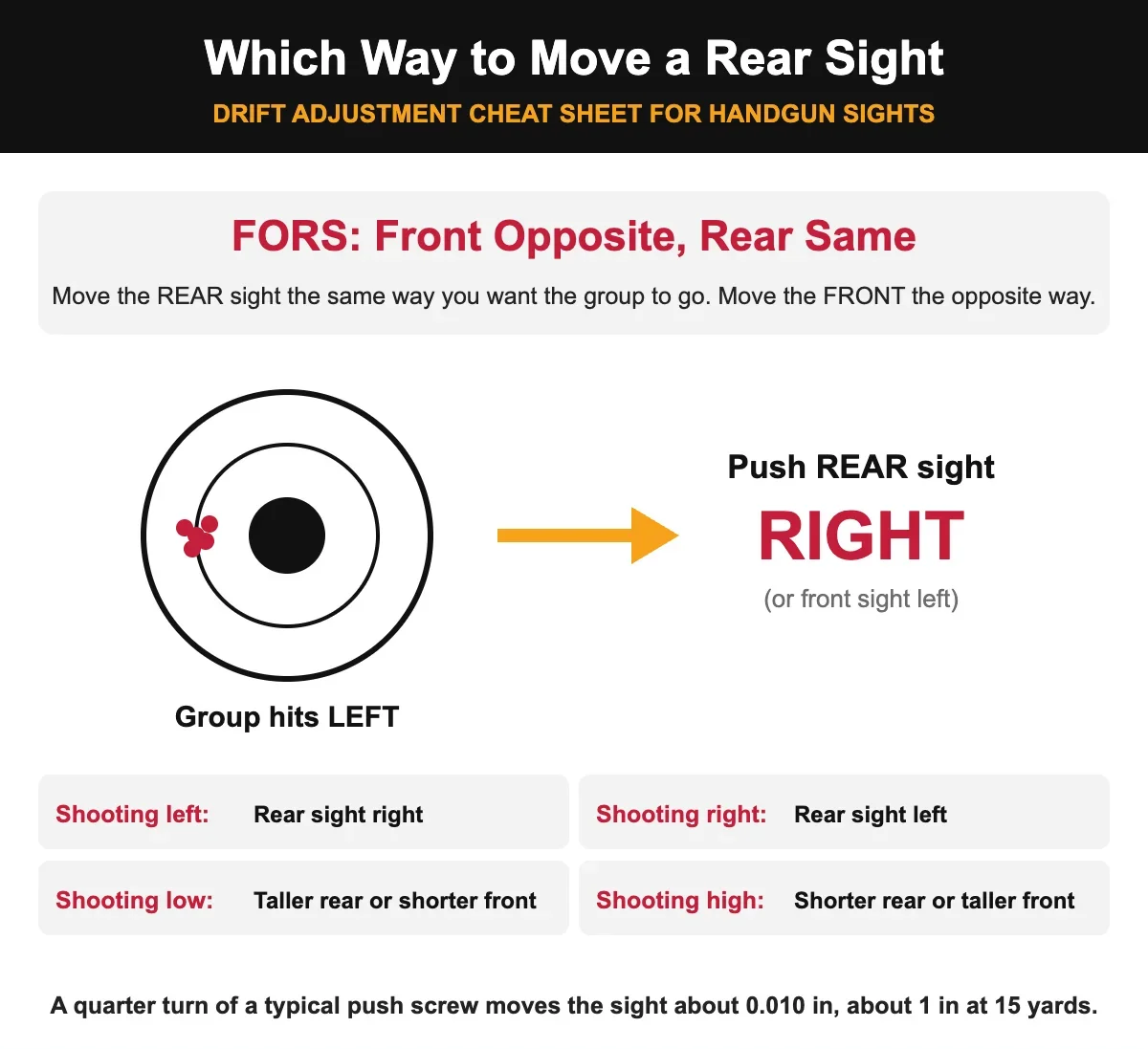
Front Opposite, Rear Same. Move the rear sight in the direction you want the group to move. Move the front sight the opposite way.
- Shooting left: move the rear sight right.
- Shooting right: move the rear sight left.
- Shooting low: rear sight up (taller rear) or front sight down (shorter front).
- Shooting high: rear sight down or front sight up (taller front).
Most pistol sights only drift for windage (left-right). Elevation on fixed sights means a different-height front or rear sight; adjustable rear sights have a screw for it.
How far to move it
Sight movement needed = (error at target × sight radius) ÷ distance to target, all in the same units. Sight radius is the distance from the rear sight face to the front sight face; on a Glock 19 it is about 6 inches, on a full-size pistol about 6.5 to 7 inches.
| Distance | Group error | Sight move (6-inch radius) | Sight move (7-inch radius) |
|---|---|---|---|
| 7 yards (252 in) | 1 inch | 0.024 in | 0.028 in |
| 10 yards (360 in) | 1 inch | 0.017 in | 0.019 in |
| 15 yards (540 in) | 1 inch | 0.011 in | 0.013 in |
| 25 yards (900 in) | 1 inch | 0.007 in | 0.008 in |
These are tiny moves. A quarter turn of a typical sight-pusher screw (about 1 mm pitch) moves the sight roughly 0.010 inch, which is about an inch of correction at 15 yards. That is why you push in quarter turns and shoot between them.
Watch: “Sight Adjustment Basics” by hickok45 on YouTube.
Doing it with a sight pusher
- Shoot a 5-shot group from a rest at a fixed distance. Measure the center of the group from the point of aim.
- Scribe or pen a witness mark across the sight and slide so you can see movement.
- Clamp the slide in the pusher as in how to use a sight pusher. Loosen the set screw, degrease.
- Calculate the move from the table. Turn the push screw in quarter-turn increments toward the direction the group needs to go (rear sight: same direction).
- Snug the set screw, shoot another group, repeat. Two rounds of this usually finishes it.
- Final: blue thread locker on the set screw, fresh witness mark.
Which direction to push the sight out and in
Separate question from windage. For removal and installation, most modern pistols drift out left to right as viewed from the rear and install right to left. Some 1911s and CZs are tapered the other way; check for a factory witness mark or measure the dovetail opening on each side. Pushing a tapered dovetail the wrong way jams the sight.
Watch: “Adjusting Rear Sights” by TheColtFirearms on YouTube.
Is it the sight or is it you?
Before you move anything: shoot from a rest, and if possible have a second shooter confirm the group. A right-handed shooter pulling low-left is a trigger-press issue, not a sight issue, and no amount of drifting fixes it. If the group moves when the shooter changes, leave the sight alone.
The tool for small, controlled moves
Windage adjustment is where a pusher beats a punch most clearly: you can move a sight 0.010 inch and stop. The Wheeler’s steel screw gives the most predictable quarter turns; the Pridefend Glock pusher is the simple choice for Glocks.
FAQ
If I am shooting left, which way do I move the rear sight?
Right. Rear sight moves the same direction you want the group to move.
How much does a quarter turn of a sight pusher move the sight?
Roughly 0.010 inch on a typical 1 mm pitch screw, about one inch of correction at 15 yards on a 6-inch sight radius.
Can I adjust elevation by drifting?
No. Drifting is windage only. Elevation on fixed sights needs a different-height front or rear sight.
We may earn a commission from qualifying purchases made through links on this page, at no extra cost to you.

Massad Ayoob
Massad Ayoob is an editorial advisor to Conceal & Carry Network on self-defense law and defensive handgun guidance. Founder and director of the Massad Ayoob Group and, before it, the Lethal Force Institute (1981–2009), he has taught armed self-defense since 1974, served as a part-time New Hampshire police officer from 1972 (retiring as a captain), testified as an expert witness in use-of-force cases since 1979, and is the author of more than thirty books including In the Gravest Extreme and Deadly Force. He is president of the Second Amendment Foundation. Advisory role; he does not test products for this site.